• Hey Guest,

    We wanted to share a quick update with the community.

    Our public expense ledger is now live, allowing anyone to see how donations are used to support the ongoing operation of the site.

    👉 View the ledger here

    Over the past year, increased regulatory pressure in multiple regions like UK OFCOM and Australia's eSafety has led to higher operational costs, including infrastructure, security, and the need to work with more specialized service providers to keep the site online and stable.

    If you value the community and would like to help support its continued operation, donations are greatly appreciated. If you wish to donate via Bank Transfer or other options, please open a ticket.

    Donate via cryptocurrency:

    Bitcoin (BTC):
    Ethereum (ETH):
    Monero (XMR):
W

watergun88

Member
Aug 13, 2026
75
man why u guys seem like are making thing so compercation ? why we talking about bars now ? my tank is , 3AA 2015 = '139 bar' . but why not just talk about CF(cubic feet)?
its way more easier , i have 1 tank of 55 cf N2 gas tank , and one 120 CF N2 gas tank . but anyway u guys should just court the LMP and how many cf your tank has , i dont think is nessary to court the 'bar' presure' in the tank
 
h4ppyhypoxia

h4ppyhypoxia

Experienced
Aug 8, 2026
245
man why u guys seem like are making thing so compercation ? why we talking about bars now ? my tank is , 3AA 2015 = '139 bar' . but why not just talk about CF(cubic feet)?
its way more easier , i have 1 tank of 55 cf N2 gas tank , and one 120 CF N2 gas tank . but anyway u guys should just court the LMP and how many cf your tank has , i dont think is nessary to court the 'bar' presure' in the tank
in the country where im from none of the tanks are listed by how many cf they are theyre listed as litre and bar
 
  • Like
Reactions: Crumblin'Castles, DeathSweetDeath and User8
B

BirdWatcher

Member
May 17, 2026
33
what have you guys done to test your exit bags / inert gas setups?
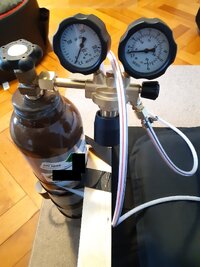
Well, I finally found time to assemble my whole setup today. Then I sat down to test the hood + tubing as well. Here's a close-up photo of my setup. I have taped the cylinder to the chair I'll be sitting in, and I have installed the regulator and tube.


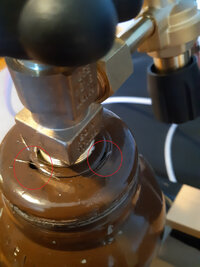
But I have not yet actually tested the gas flow. For two reasons: First, I couldn't find a pliers big enough to grip the screw nut that connects the regulator and the gas bottle. I think that connection should be as tight as possible before trying anything with pressurized gas. I'll get one tomorrow. And second, while looking at it closely I discovered that my gas cylinder appears to have multiple small holes in it, right next to where the bronze (?) valve connects to the brown bottle. Does anyone here know if this is normal and harmless? Or did I get a damaged bottle? I sure hope there's actually gas in there and it's not just empty ...

Here's an image of the holes:
 
  • Love
  • Wow
Reactions: Crumblin'Castles, User8 and h4ppyhypoxia
D

devils~advocate

Specialist
Feb 29, 2024
368
Do you have a photo of the hood? Im curious how it was constructed.
 
B

BirdWatcher

Member
May 17, 2026
33
Ok, I have an update with very bad news:

I contacted the seller, with that image of the holes attached, and asked if the bottle is damaged. They told me that this is supposedly normal and that all cylinders look like this. The only thing they recommended me was to screw the regulator on as tight as possible. This sounded very sketchy, but ok.
About an hour ago I got a spanner delivered. I immediately went to test my gas setup again and tightened everything as best I could. Then I opened the valve on top of the cylinder for the first time ...
And gas came out of the holes in the metal bottle, with a loud hissing sound. There was also a bit of pressure on the regulator, but I could not get anything out of it. Playing around with a damaged, pressurized gas bottle inside an apartment bedroom is probably dangerous, so I quickly closed the valve again.

I'm completely devestated right now. Too tired to even get angry. I immediately ordered another helium cylinder form a different seller and brand (same size, pressure, connector and overall design though). This will cost me another 220 EUR and will arrive on saturday at the earliest, possibly on tuesday. I have been procrastinating my ctb over the last weeks (not least because I still have a fcking scaffold right in front of my window). But I had planned to ctb this weekend, made my peace with it, set everything up, and wanted to have a few nice last days. I specifically wanted to die before tuesday, for certain reasons. Now it looks like I'll probably have to wait longer.

I don't even know what to do with the damaged bottle now. I guess I can put it back in the box and into a corner somewhere. And before I ctb I'll put a note on it that tells the police (who I will inform with a timed email) what's in there, that this needs to be disposed off and the seller investigated.

Holy hell, why am I cursed with such bad luck? My entire life has been nothing but failure and suffering, and now I can't even kms ...


Do you have a photo of the hood? Im curious how it was constructed.
With "hood" I just meant a standard exit bag. Made from a large oven bag and an elastic string with a stopper.
 
  • Wow
Reactions: Crumblin'Castles
B

BirdWatcher

Member
May 17, 2026
33
Adding to my last post:

Now that I've had some time to calm down about how bad it is to have gotten a damaged cylinder I've come to the realisation ... how bad it is to have a damaged cylinder!

I only thought about it in terms of how this won't let my ctb. But ofc having a possible unstable tank of 8L at 150 bar in my room could be quite dangerous for me and everyone around. And I have no idea what to do about it. Normally I should contact the seller of course. But I already did this and they told me off. I guess normally I should keep insisting with them to help me, or even call the police to get involved to get this thing off my hands. But I also do not want to draw any attention to me, and I especially do not want the police to come here and ask questions about why I have an industrial helium cylinder.

I know this is way outside the purview of this forum, but I'm panicking right now and have no one else to talk to. Do you guys think I can just keep the tank here until I ctb in a week at most? And then let it be the problem of the police, as I said above. I've had it here for five weeks already after all, and nothing happened.

I have also just ordered a foldable hand truck. It will arrive in two days or so. This would let me transport the cylinder somewhere more safe. I live near a forest. I could potentially go out at night and hide it somewhere in the woods. I could possibly even put it in the woods, open the valve a bit and let the gas slowly evaporate? Can you open the valve of a tank like this a bit without a flowmeter on? Because I don't want to lose that thing. I know one should probably not move a damaged pressurized tank at all, but I've already hauled it through the city and transported it with the tram, then moved it around repeatedly here in my apartment.

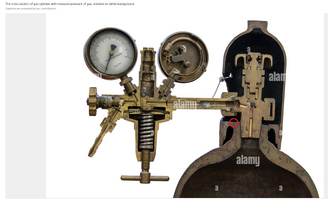
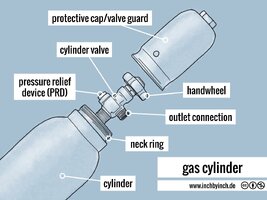
One fear I have is that the tank might have been fine so far, but that opening it today might have put pressure on the hole and made it more unstable. I don't even understand how that leak is possible. I've searched for cylinder crosscuts online, and the part where the hole is should not at all connect to the tank's actual chamber. And as I said: The gas only hissed out of the hole after I turned the valve open. WHich also should not connect there. Here's an image of where I think the hole goes through (compare to my earlier image above):


Sorry for this long, incomprehensibly rambling and off-topic post. But I'm really panicking right now and don't know what to do.

EDIT:
I've been watching gas safety videos for a while now. And I just came upon this video that repeatedly demonstrates what the guys call "to crack the cylinder": Quickly open and close the valve so the gas can blow any possible debris out of the connector. So I guess it it's allowed to open a cylinder without a regulator attached. Atleast for a second. But in my case opening the valve is exactly what somehow puts gas through the damaged hull. So I'm still not sure if I can just hide the cylinder in the forest and let it empty out safely.

EDIT 2: My plan for this evening had been to chill and watch the gamescom livestream. Insted I just spent 5 hours learning about gas cylinder engineering. Though I admit I still don't understand a lot. From what I do understand: My gas is escaping through holes between where the cylinder and the neck ring connect. It only escapes when the valve is turned open, meaning the neeadle seal of the valve works. The leakage might or might not be from a broken safety reliefe port or a broken gasket that were weirdly placed under the neck ring. In which cases the holes might or might not have been put there on purpose to let the pressure escape. All of this might or might not mean that the actual steel body of the cylinder is not cracked, instead there's a problem somewhere in the upper valve that only comes into play if the handwheel is turned and the needle moved. Which could mean that the whole thing might not explode on me tonight, and I can go to sleep.

 
Last edited:
  • Like
  • Informative
Reactions: Crumblin'Castles and flowersforalgernons
User8

User8

Life is short. Make it shorter
Jul 13, 2024
75
how bad it is to have a damaged cylinder!
It seems that you are in the EU. There is a vendor, a very big and well known company in Poland, which sends brand new cylinders, filled, anywhere in the EU, for cheap, I mean you won't find cheaper. I got my 5L 200bar cylinder for just 102€ delivered to my address. It is against the rules to publicly share brand names, so, if you want to know the information just send me a private message.
 
L

lexion

Member
Feb 14, 2023
5
Picked up a 40 cu ft tank of industrial grade nitrogen range is stated from 95-99.5 percent. if at low range 95% still effective for ctb?
 
User8

User8

Life is short. Make it shorter
Jul 13, 2024
75
Picked up a 40 cu ft tank of industrial grade nitrogen range is stated from 95-99.5 percent. if at low range 95% still effective for ctb?
You might succeed but will it be peaceful??
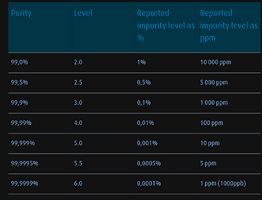
I don't think it is effective for a peaceful ctb. You want a real 0% oxygen environment. I say grade 2.5 (99.5% purity) would be the minimum. Ideally, like most of us have got, 4.0 (99.99 purity)
 

Attachments

  • gas purity table.png
    gas purity table.png
    83.5 KB · Views: 0
  • Like
Reactions: Crumblin'Castles and DeathSweetDeath
B

BirdWatcher

Member
May 17, 2026
33
It is against the rules to publicly share brand names, so, if you want to know the information just send me a private message.
Thank you for the kind offer, that I might come back to if all else fails. But in the meantime I have already ordered another tank. To be imported from an eastern european country, but not poland. It's scheduled to arrive tomorrow. I hope this time they'll actually bring it to my door instead to a pickup shop somewhere else.
 
ctb_warrior

ctb_warrior

I wish to CTB asap
Feb 11, 2024
1,423
Adding to my last post:

Now that I've had some time to calm down about how bad it is to have gotten a damaged cylinder I've come to the realisation ... how bad it is to have a damaged cylinder!

I only thought about it in terms of how this won't let my ctb. But ofc having a possible unstable tank of 8L at 150 bar in my room could be quite dangerous for me and everyone around. And I have no idea what to do about it. Normally I should contact the seller of course. But I already did this and they told me off. I guess normally I should keep insisting with them to help me, or even call the police to get involved to get this thing off my hands. But I also do not want to draw any attention to me, and I especially do not want the police to come here and ask questions about why I have an industrial helium cylinder.

I know this is way outside the purview of this forum, but I'm panicking right now and have no one else to talk to. Do you guys think I can just keep the tank here until I ctb in a week at most? And then let it be the problem of the police, as I said above. I've had it here for five weeks already after all, and nothing happened.

I have also just ordered a foldable hand truck. It will arrive in two days or so. This would let me transport the cylinder somewhere more safe. I live near a forest. I could potentially go out at night and hide it somewhere in the woods. I could possibly even put it in the woods, open the valve a bit and let the gas slowly evaporate? Can you open the valve of a tank like this a bit without a flowmeter on? Because I don't want to lose that thing. I know one should probably not move a damaged pressurized tank at all, but I've already hauled it through the city and transported it with the tram, then moved it around repeatedly here in my apartment.

One fear I have is that the tank might have been fine so far, but that opening it today might have put pressure on the hole and made it more unstable. I don't even understand how that leak is possible. I've searched for cylinder crosscuts online, and the part where the hole is should not at all connect to the tank's actual chamber. And as I said: The gas only hissed out of the hole after I turned the valve open. WHich also should not connect there. Here's an image of where I think the hole goes through (compare to my earlier image above):


Sorry for this long, incomprehensibly rambling and off-topic post. But I'm really panicking right now and don't know what to do.

EDIT:
I've been watching gas safety videos for a while now. And I just came upon this video that repeatedly demonstrates what the guys call "to crack the cylinder": Quickly open and close the valve so the gas can blow any possible debris out of the connector. So I guess it it's allowed to open a cylinder without a regulator attached. Atleast for a second. But in my case opening the valve is exactly what somehow puts gas through the damaged hull. So I'm still not sure if I can just hide the cylinder in the forest and let it empty out safely.

EDIT 2: My plan for this evening had been to chill and watch the gamescom livestream. Insted I just spent 5 hours learning about gas cylinder engineering. Though I admit I still don't understand a lot. From what I do understand: My gas is escaping through holes between where the cylinder and the neck ring connect. It only escapes when the valve is turned open, meaning the neeadle seal of the valve works. The leakage might or might not be from a broken safety reliefe port or a broken gasket that were weirdly placed under the neck ring. In which cases the holes might or might not have been put there on purpose to let the pressure escape. All of this might or might not mean that the actual steel body of the cylinder is not cracked, instead there's a problem somewhere in the upper valve that only comes into play if the handwheel is turned and the needle moved. Which could mean that the whole thing might not explode on me tonight, and I can go to sleep.

It's not your mistake and not your bad luck. Most people just play around and try to get rid of faulty products by duping innocent people. It's really mean. There are scammers who say that they sell nembutal but they just fool around.
 
  • Aww..
Reactions: Crumblin'Castles
DeathSweetDeath

DeathSweetDeath

Visionary
Nov 12, 2025
2,469
man why u guys seem like are making thing so compercation ? why we talking about bars now ? my tank is , 3AA 2015 = '139 bar' . but why not just talk about CF(cubic feet)?
its way more easier , i have 1 tank of 55 cf N2 gas tank , and one 120 CF N2 gas tank . but anyway u guys should just court the LMP and how many cf your tank has , i dont think is nessary to court the 'bar' presure' in the tank
Yeah they do not come in cubic feet in much of the world apparently, I was in disbelief when I first saw it, too. They absolutely do need to do that math to calculate how many liters they actually have.
 
L

lexion

Member
Feb 14, 2023
5
Picked up a 40 cu ft tank of industrial grade nitrogen range is stated from 95-99.5 percent. if at low range 95% still effective for ctb?
I used a calibrated o2 meter in bag with hose and it went down to .1 percent so it looks adequate. It's to the high end - closer to 99 instead of near 95.
 
  • Informative
Reactions: Crumblin'Castles
D

devils~advocate

Specialist
Feb 29, 2024
368
I used a calibrated o2 meter in bag with hose and it went down to .1 percent so it looks adequate. It's to the high end - closer to 99 instead of near 95.
Can you give a model or photo of the O2 meter. Im trying to test my supply as well.
 
B

BirdWatcher

Member
May 17, 2026
33
I have good news: I'm a complete idiot lol :-)

I got a new cylinder delivered today. It too has holes on the top, but I now know that this is normal. It's just the seam where the neckring piece is pressed around the bottle neck. This second bottle worked without a problem, I could get 150 bar from it and regulate it down to 6 L/min on the argon meter, which should be ca. 18 L/min for the actual helium flow.
This got me curious to take another look at my first cylinder. I put the regulator on it ... and this time no gas escaped from those holes. Which should have been impossible to begin with, given what I now know about the construction of these bottles. I was 100% certain that there was a leak there. I had put my hand at the holes and felt a stream of gas. I guess it is possible that I didn't screw the regulator on tight enough the first time, so there was a leak around that connector, which was directed downwards and then hit the top of the bottle to be reflected upwards. I'm feeling pretty silly right now.

Sorry for making this thread my personal blog. But I hope my experiences can perhaps be helpful for future users coming here. Not just about the technical details of working with gas cylinders, but in general: I would advise everyone to take the time and calmly familiarize yourself with your equipment. Which I know is no new suggestion, but it really is very important.
 
  • Love
  • Like
Reactions: Crumblin'Castles and User8
O

outrider567

Illuminated
Apr 5, 2022
3,048
Picked up a 40 cu ft tank of industrial grade nitrogen range is stated from 95-99.5 percent. if at low range 95% still effective for ctb?
Yes, even 95% Nitrogen is lethal and not survivable
 
S

sm1the

Experienced
Sep 18, 2022
209
I used a calibrated o2 meter in bag with hose and it went down to .1 percent so it looks adequate. It's to the high end - closer to 99 instead of near


What's the accuracy of the tester?.
I posted this elsewhere but I'm going to post this here as well since its relevant to thread subject.

I have done 2 tests with an ELSA/EEBD using a styrofoam dummy head (with partial/very slight shoulders).
During both times I was quite surprised at how much it inflated(25lpm N2).
The EEBD was quite firm almost like (but not fully? I'm uncertain how to describe it) like a baloon.
It wasn't wrinkled or collapsed in anyway ,in any part of it.
Is this normal behaviour?, obviously I don't have any experience with these so I want to make sure.
Also,I could hear the venting from the exhale valve(I'm guessing this is correct behaviour).
A while back I tested a different ELSA I purchased late last year.
I don't remember this one inflating quite so much.
I did leak tests on connected equipment on both.
 
snailluvr

snailluvr

Member
Sep 7, 2024
5
hi guys. i was originally planning on doing this method in a hotel room but my location is being tracked now and it will be hard to check into a hotel / drive there without being questioned. but im worried about doing this method at home because i have a cat now and i dont know if the gas will hurt her (i got a pretty big tank). should i put her in like a cat hotel when i do it?
 
S

sm1the

Experienced
Sep 18, 2022
209
Can you give a model or photo of the O2 meter. Im trying to test my supply as well.


Most devices ppl use here commonly are oxygen deficiency monitors designed to alert users to low or high oxygen danger, rather than to provide highly accurate oxygen concentration readings.

For accurately testing oxygen concentration in a space, a percent oxygen analyzer is the appropriate tool. These typically measure ranges such as 0-25% or 0-100% oxygen.

When searching for equipment, the terms "Oxygen concentration tester" or "Oxygen analyzer" yield better results for analytical devices, whereas "portable oxygen detector" or "Oxygen safety monitor" generally refer to safety alarming equipment.

While a lower measurement range (such as 0-5% or 0-10%) would be ideal for measuring severely depleted oxygen, affordable options are typically limited to the 0-25% range. Devices that measure trace amounts of oxygen (measured in parts per million or fractions of a percent) are specialized instruments and generally cost significantly more, often ranging from $300 to $5,000.

A critical technical detail to note is that the electrochemical sensors used in many oxygen analyzers begin deteriorating from the date of manufacture, regardless of whether they are actively being used.
Therefore, it is important to determine the age of the device before purchasing. If the exact Date of Manufacture (DOM) is unavailable, checking for dates on the packaging—such as the initial calibration date or CE certification date—can provide a reasonable estimate of the sensor's age.

There is 1 brand that is affordable and from what I see it is used widely in different places that need an accurate ,cheap o2 analyser.

Just my experience!

BTW its in here-
Thread 'Nitrogen gas with EEBD hood Guide (Inert gas Method)'
 
Last edited:
  • Like
Reactions: pthnrdnojvsc
W

watergun88

Member
Aug 13, 2026
75
  • Love
Reactions: User8
W

watergun88

Member
Aug 13, 2026
75
D

This is not the one I would use.
This is a Oxygen detector /personal ,wearable type of low oxygen alarm.its not meant for testing low O2 environments specifically but to assure you that you are at 20.9% O2 environment.
Obviously u can use it,it will give u a % but it won't be completely accurate.
Just my 2 cents
what? no, are u sure? i think this is prefect for it tho ? i put it in the bag and fill the bag with N2 , and it will keep going lower untill 0 % .

i have thinking of buying the oxygen analyer but that one is to test the air straight out of the tank .https://www.forensicsdetectors.com/products/oxygen-scuba

and i dont think that matter mush? as long as my detector goes below 5%? or even 0 % ?
 
S

sm1the

Experienced
Sep 18, 2022
209
what? no, are u sure? i think this is prefect for it tho ? i put it in the bag and fill the bag with N2 , and it will keep going lower untill 0 % .

i have thinking of buying the oxygen analyer but that one is to test the air straight out of the tank .https://www.forensicsdetectors.com/products/oxygen-scuba

and i dont think that matter mush? as long as my detector goes below 5%? or even 0 % ?
I accidentally deleted my post while editing it lol.
Getting one with a newly made sensor (<6months)is important (if u can manage it).
Also important to calibrate this your self before doing anything with it I learnt.
Smart sensor ar8100 is what I got.
1.5% error.
 
W

watergun88

Member
Aug 13, 2026
75
I accidentally deleted my post while editing it lol.
Getting one with a newly made sensor (<6months)is important (if u can manage it).
Also important to calibrate this your self before doing anything with it I learnt.
Smart sensor ar8100 is what I got.
1.5% error.
bro, ur sensor work the same as mine mostly, but urs does has temperature measurement also. but you cant just tell me mine doesnt work lol
 
User8

User8

Life is short. Make it shorter
Jul 13, 2024
75
Yeah they do not come in cubic feet in much of the world apparently, I was in disbelief when I first saw it, too. They absolutely do need to do that math to calculate how many liters they actually have.
The math is easy:

Compressed-gas cylinders are rated by water capacity (the internal volume in litres) and filling pressure (in bar).

Example: 5L cylinder x 200bar = 1000 litres.

This formula is the only practical way to refeir to how many litres there are in any given cylinder.
 
  • Like
Reactions: DeathSweetDeath
S

sm1the

Experienced
Sep 18, 2022
209
bro, ur sensor work the same as mine mostly, but urs does has temperature measurement also. but you cant just tell me mine doesnt work lol
I never said yours doesn't work.please read what I said.
These work in Similar ways,they both have electro chemical sensors.
Yours 5% FS error rate, mine 1.5%FS.
mine is specifically made for testing gases etc for labs,schools etc so its very similar for my needs.

Not the same!.
This isn't a competition though right :).
I always criticise every thing I do in the hopes I will discover faults,find better equipment etc.


.
 
  • Like
Reactions: watergun88
S

sm1the

Experienced
Sep 18, 2022
209
I did another dummy test.
This time I cut out part of the dummy.
I cut 1/4 off the top from nose from the bridge down to just above back neck.
Then I cut out a hole in the middle of the head and planted the oxygen analyzer there.

Gas start.
Gas off 20.9% 02.
Gas on @ 7s, 15% O2.
Gas on @ 19s 5% O2.
Gas on @ 30s 2% O2.
Gas on @ 39s 1% O2.
Gas on @ 1min12s 0% O2.

Gas off at 1min12s.

2min45s 0% O2
2min50s 0.1% O2
4min38s 0.6% O2
7m46s 1.4% O2
10m13s 1.9% O2


I stopped at about 10 mins as it was still only 1.9% O2.
 
S

sm1the

Experienced
Sep 18, 2022
209
Hey folks!.

EEBD hose positioning-over shoulder,over chair.

I'm contemplating positioning the hose coming directly out of the EEBD(black hose on my ELSA but relates to other models,brands too) to go upwards over my shoulder and top of the back rest and around to the left where the cylinder is(tape to be used in several spots to keep hose where its meant to be)
The hose junction at the elsa can be rotated around to achieve this.
I was thinking this would further reduce risk of me unconsciously messing with the hose.
Has anyone thought of something similar? or does this seem sensible and practical?.
 
P

plimeix

Member
May 14, 2026
39
Anyone have advice around safe transport and general storage for nitrogen tanks? My biggest fear after researching a bit more is accidentally compromising the valve and having the tank become a torpedo..
 
S

sm1the

Experienced
Sep 18, 2022
209
Anyone have advice around safe transport and general storage for nitrogen tanks? My biggest fear after researching a bit more is accidentally compromising the valve and having the tank become a torpedo..
I have mine strapped to a heavy duty moving trolley(the HEAVY DUTY ones and not the flimsy portable ones or folding ones that ladies take to the shops!).
Ideally though I would strap it to a wall or something much heavier using cylinder wall straps(about $30 depending...).
Made sure nothing overhead or on the sides could fall onto it(and damage valve).
Used a sheet of rubber underneath to protect from damage,moisture etc.
 
  • Love
Reactions: plimeix

Similar threads

G
Replies
12
Views
496
Suicide Discussion
George77
G
T
Replies
1
Views
444
Suicide Discussion
BirdWatcher
B
Ima-username
Replies
46
Views
5K
Suicide Discussion
Somewhat Suicidal
Somewhat Suicidal