

S
Syriancel
Member
- Jan 6, 2021
- 40
I see many people on this site talking about Carbon Monoxide method but not as many people talk about hydrogen sulfide. Is it unreliable? It seems very easy as described in the PPEH.
We wanted to share a quick update with the community.
Our public expense ledger is now live, allowing anyone to see how donations are used to support the ongoing operation of the site.
👉 View the ledger here
Over the past year, increased regulatory pressure in multiple regions like UK OFCOM and Australia's eSafety has led to higher operational costs, including infrastructure, security, and the need to work with more specialized service providers to keep the site online and stable.
If you value the community and would like to help support its continued operation, donations are greatly appreciated. If you wish to donate via Bank Transfer or other options, please open a ticket.
Donate via cryptocurrency:


It's one of the strongest and fast-acting poisons. If produced with proper reagents and used for CTB in a sensible manner, reliability is close to 100%. But it maybe somewhat unpleasant to inhale. Carbon monoxide is a less potent poison, but it's completely odorless and non-irritating (when it's not mixed with smelly impurities like fumes of formic acid). There are many ways to make CO at high concentrations, but they're commonly more complicated than making lethal concentrations of H2S.Is it unreliable?

It can be done in an open area like forest. If you trap H2S inside a plastic bag over the head, you wouldn't need those excessive amounts of this gas which people commonly use to fill large confined spaces. For example, 200 ml of H2S is enough to produce concentrations of 10000 - 20000 ppm inside a volume of 10 L, and such concentrations are more than sufficient for achieving rapid unconsciousness, respiratory arrest, and death.I don't like the idea of it hurting those who find the body, though. You would have to have some way of very clearly signposting that the room/area in which you have died is filled with hydrogen sulfide and must not be entered without heavy precautions, but at the same time ensure that nobody sees this signposting until you are guaranteed to have died.
This is probably the best thing to do imo. Away from public. Ideally won't be discovered for at least a few days to make sure the reaction is complete and the gas has dissipated. Warning signs are still useful in any scenarios.It can be done in an open area like forest. If you trap H2S inside a plastic bag over the head, you wouldn't need those excessive amounts of this gas which people commonly use to fill large confined spaces. For example, 200 ml of H2S is enough to produce concentrations of 10000 - 20000 ppm inside a volume of 10 L, and such concentrations are more than sufficient for achieving rapid unconsciousness, respiratory arrest, and death.
I thought it was more difficult to get the ingredients now, at the proper concentration levels.Reagents are really accessible. I am considering this. I'm worried that retrieval of a body is putting rescuers/observers nearby in danger. I planned on doing it in a hotel closet or bathroom, but thought the scene and the aftermath is pretty dangerous to deal with.
You're right. It is, in some countries. However, I'm in SE Asia. Calcium sulfide, HCL and other alternatives to these two are available online. It's like ordering cleaning detergents. I got my SN online without any issue or special permit. SN is harder to procure compared to the materials for H2S, at least from where I'm from.I thought it was more difficult to get the ingredients now, at the proper concentration levels.
I'm in US I don't think easy here. This might sound odd but if sn and h2s are accessible; why not both? Aside from risk to others from h2s.You're right. It is, in some countries. However, I'm in SE Asia. Calcium sulfide, HCL and other alternatives to these two are available online. It's like ordering cleaning detergents. I got my SN online without any issue or special permit. SN is harder to procure compared to the materials for H2S, at least from where I'm from.
This forum made me realize how chemical bans are wildly different between regions.
It's not weird. Definitely wild a thought, but I have contemplated on combining these methods out of desperation as well. But yeah, collateral damage is my main worry with h2s. I don't have any other excuse.I'm in US I don't think easy here. This might sound odd but if sn and h2s are accessible; why not both? Aside from risk to others from h2s.
 WARNING DO NOT ATTEMPT)
Since NaNO2 works as an antidote for H2S and hydrogen sulfide is a way more potent poison than sodium nitrite, consuming both doesn't make sense, in my opinion.Do the standard SN regime then proceed with h2s.
Thank you for sharing this. That's true. Similar to Cyanide salts, H2S targets cellular level respirstion. I knew that SN is proposed as an aid in managing CN and H2S poisoning, although the antidotal efficacy of nitrite therapy is controversial, with only anecdotal evidence supporting its effectiveness. It is conditional, to put it simply.Since NaNO2 works as an antidote for H2S and hydrogen sulfide is a way more potent poison than sodium nitrite, consuming both doesn't make sense, in my opinion.
The immediate effect of inhaling H₂S at concentrations 1000 to 2000 ppm (1390 to 2780 mg/m³) for a few minutes are unconsciousness and respiratory paralysis, which may lead to death due to inhibition of the respiratory center of the brain. Inhalation of only 1 or 2 breaths of air containing 5000 ppm (7000 mg/m³) H₂S causes unconsciousness.
Usually acute intoxication occurs from a single, massive exposure of 2000 ppm (2781 mg/m³) or more, and unconsciousness occurs within a few seconds, without significant warning or pain. Unconsciousness, termed "knock-down" by workers, is almost immediately followed by respiratory paralysis, and after that by a short period of tonic convulsions (Yant, 1930). The heart continues to beat for several minutes. Death occurs unless the victim is removed from the contaminated area and artificial ventilation is immediately initiated.
The amount of Al2S3 showed on this video would suffice for killing a person if the produced gas is collected in a plastic bag and then inhaled from there.
[Hidden content]
In a large ventilated room, small amounts of H2S would quickly dissipate without posing serious risks for health and life.
Wait, really? Have there been any instances of someone successfully doing this? I hate the idea of endangering othersIt can be done in an open area like forest. If you trap H2S inside a plastic bag over the head, you wouldn't need those excessive amounts of this gas which people commonly use to fill large confined spaces. For example, 200 ml of H2S is enough to produce concentrations of 10000 - 20000 ppm inside a volume of 10 L, and such concentrations are more than sufficient for achieving rapid unconsciousness, respiratory arrest, and death.
Wait, really? Have there been any instances of someone successfully doing this? I hate the idea of endangering others


the diffences in the co and h2s Ppm for lethality is time .In my opinion, H2S is better (maybe more reliable or peaceful) than CO. Both substances can cause rapid unconsciousness and death in high level exposure. This chemical property is obviously favorable for us. They are apparently similar. However I think H2S has some superiority over CO.
As for CO, the required amount is probably:
There is a confusion. 12,800 ppm might be best for safety. On the other hand the required amount of H2S is 700-1000 ppm, which is less than the CO amount.
- 1,950 ppm (WHO says)
- 12,800 ppm (Wikipedia says. But the references on the table are not backing up. I wonder why this article is marked as a good article)
- 10,000 ppm (SaSu members say. I don't know where is the source)
And only 120mL of sulfide bath essense and toilet bowl cleaner can produce this concentration of H2S in a 3,300L cabin. To fill the 3,300L volume, you need 1.34kg of charcoal (3,300L x 0.001 x 0.135kg/m³ x 3, see also). If you want to increase the amount for more rapid effect or larger cabin capacity, it's easy to bring 1200ml (multiplied by 10) of the sulfide solution and the acid, but it's a bit demanding to bring 13.4kg of charcoal. This problem might be solved by the reaction of formic acid and sulfuric acid, ...if you're willing to build the GULPS generator PPH suggests.
In conclusion, I believe H2S method is easier to prepare the materials for producing much gas beyond the fatal level. I would rather recommend H2S than CO. Any opinions welcomed.

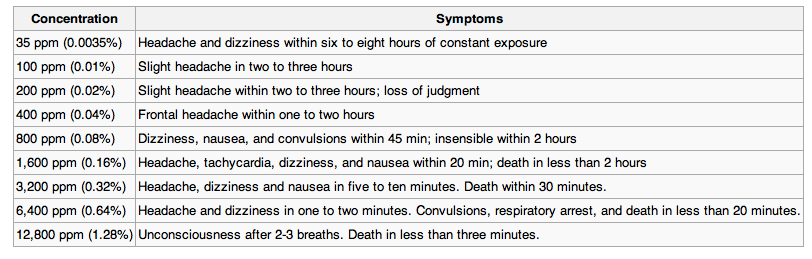
Yes, I'm suggesting the concentration that cause rapid (probably few seconds) unconsciousness or death. It's probably 12800 (or 1950 or 10000) ppm in CO. It's 700-1000 ppm in H2S. Those concentration levels are so strong that the process will be painless. I don't think it's comfortable stay in the room filled with 1500 ppm CO for 2 hours.the diffences in the co and h2s Ppm for lethality is time .
800 ppm or 1500 ppm of co can be deadly in 2 hours of constant exposure , 400 ppm can be life threatening after 3 hours
Wait, really? Have there been any instances of someone successfully doing this? I hate the idea of endangering otherIt can be done in an open area like forest. If you trap H2S inside a plastic bag over the head, you wouldn't need those excessive amounts of this gas which people commonly use to fill large confined spaces. For example, 200 ml of H2S is enough to produce concentrations of 10000 - 20000 ppm inside a volume of 10 L, and such concentrations are more than sufficient for achieving rapid unconsciousness, respiratory arrest, and death.
Very helpful, thank you!


