Over the past year, increased regulatory pressure in multiple regions like UK OFCOM and Australia's eSafety has led to higher operational costs, including infrastructure, security, and the need to work with more specialized service providers to keep the site online and stable.
If you value the community and would like to help support its continued operation, donations are greatly appreciated. If you wish to donate via Bank Transfer or other options, please open a ticket.
Donate via cryptocurrency:
Bitcoin (BTC):
Ethereum (ETH):
Monero (XMR):
ResourceThoughts on potassium silver cyanide KAg(CN)2
Thread starterJohnM66
Start date
You are using an out of date browser. It may not display this or other websites correctly. You should upgrade or use an alternative browser.
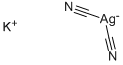
Is this compound as toxic and lethal as KCN? I've been looking up on the internet and found out that this one is way more accessible than KCN, I found some of these compounds with a concentration of about 54% and have been wondering if it's enough to CTB.
I couldn't find any quantitative data on toxicity of potassium dicyanoargentate for humans. For rats, LD50 of K[Ag(CN)₂] is 20.9 mg/kg, LD50 of KCN is 7.49 mg/kg, LD50 of NaCN is 5.733 mg/kg according to
The reason why a higher weight of potassium dicyanoargentate is needed is probably because it has a higher molecular weight (199 g/mol vs 65 g/mol for KCN vs 49 g/mol for NaCN) and the complex ions [Ag(CN)₂]⁻ produced after dissociation of K[Ag(CN)₂] in water have to be decomposed further in order to produce poisonous CN⁻ anions.
I couldn't find any quantitative data on toxicity of potassium dicyanoargentate for humans. For rats, LD50 of K[Ag(CN)₂] is 20.9 mg/kg, LD50 of KCN is 7.49 mg/kg, LD50 of NaCN is 5.733 mg/kg according to
The reason why a higher weight of potassium dicyanoargentate is needed is probably because it has a higher molecular weight (199 g/mol vs 65 g/mol for KCN vs 49 g/mol for NaCN) and the complex ions [Ag(CN)₂]⁻ produced after dissociation of K[Ag(CN)₂] in water have to be decomposed further in order to produce poisonous CN⁻ anions.
Potassium dicyanoargentate (CAS 506-61-6) information, including chemical properties, structure, melting point, boiling point, density, formula, molecular weight, uses, prices, suppliers, SDS and more, available at Chemicalbook.
www.chemicalbook.com
give potassium dicyanoargentate the highest health hazard level per NFPA 704 - 4 of 4.
Sodium nitrite is typically scored as 3 of 4 hazard level per NFPA 704
On the other hand, potassium dicyanoargentate is described as a severe irritant for skin, mucous membranes, and eyes. So ingesting it can be way more unpleasant than sodium nitrite.
If you're ready to consider making hydrogen cyanide out of this substance instead of swallowing it just as is, I think it should be suitable for producing a lethal dose of HCN (similarly to potassium ferrocyanide and potassium ferricyanide which also may be available for purchasing by individuals in many countries).
Potassium dicyanoargentate (CAS 506-61-6) information, including chemical properties, structure, melting point, boiling point, density, formula, molecular weight, uses, prices, suppliers, SDS and more, available at Chemicalbook.
www.chemicalbook.com
give potassium dicyanoargentate the highest health hazard level per NFPA 704 - 4 of 4.
Sodium nitrite is typically scored as 3 of 4 hazard level per NFPA 704
On the other hand, potassium dicyanoargentate is described as a severe irritant for skin, mucous membranes, and eyes. So ingesting it can be way more unpleasant than sodium nitrite.
If you're ready to consider making hydrogen cyanide out of this substance instead of swallowing it just as is, I think it should be suitable for producing a lethal dose of HCN (similarly to potassium ferrocyanide and potassium ferricyanide which also may be available for purchasing by individuals in many countries).
Probably not easy, since producing HCN from this compound seems to require heating a mixture of it with some strong acid like HCl, H2SO4, or HNO3, and it's somewhat difficult to find detailed info about such reactions. There is way more info about reactions between ferrocyanides or ferricyanides with strong acids that can also produce HCN.
Is this compound as toxic and lethal as KCN? I've been looking up on the internet and found out that this one is way more accessible than KCN, I found some of these compounds with a concentration of about 54% and have been wondering if it's enough to CTB.
This site uses cookies to help personalise content, tailor your experience and to keep you logged in if you register.
By continuing to use this site, you are consenting to our use of cookies.