


DarkRange55
🎂
- Oct 15, 2023
- 2,421
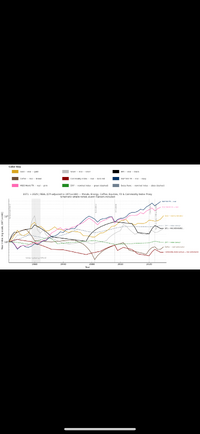
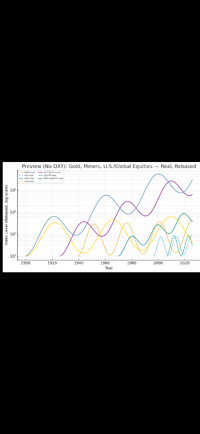
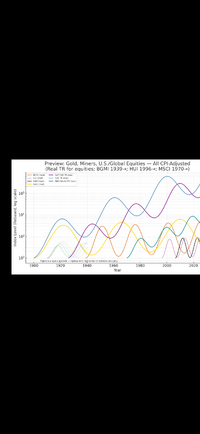
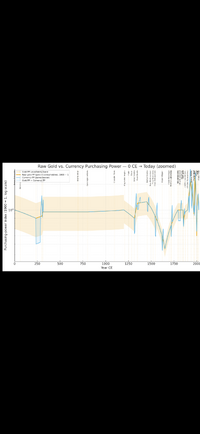
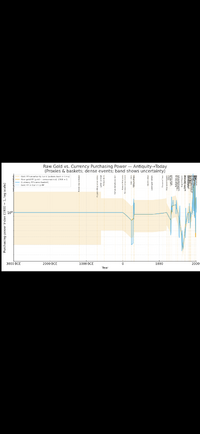
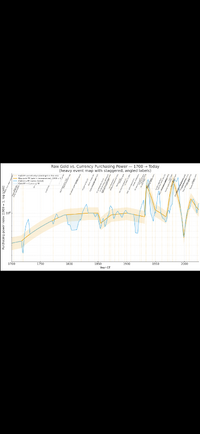
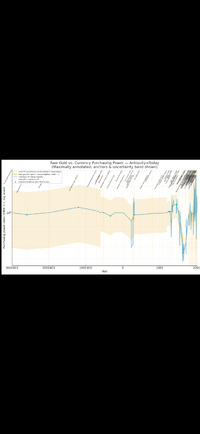
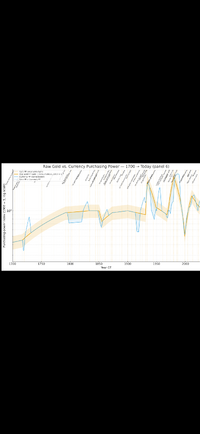
Hi SaSu! For those interested, please see the attached slides below. Much of this is reconstructed and extrapolated from scholarly sources such as The Golden Constant. However, any extrapolation should be taken with a grain of salt. Keep in mind, this is not precise and indeed exact precision would be nearly impossible for many reasons. Even tracking the historical prices of bread to antiquity get extremely messy…
Gold's purchasing power oscillates around a long-term average, but it can swing by multiples for decades. Goldbugs treat gold as if it's a magical, self-adjusting constant of value — when in reality it's just another asset whose real purchasing power fluctuates depending on broader conditions. Sometimes an ounce buys far more (e.g., Great Depression). Sometimes far less (e.g., 1990s boom). Gold has no mystical property keeping it pegged to "value" — it's just scarce, durable, and globally recognized. Those traits give it long-term monetary gravity, not perfection.
If gold were a thermometer (like CPI), its price would rise one-for-one with inflation. But it doesn't. Gold is a barometer — it reacts to pressure changes. When people expect inflation to stay high and real yields to stay low, they rush into gold. When confidence in central banks rises, even with inflation present, gold cools off.
It's measuring sentiment and policy pressure, not the temperature itself.
Even if both CPI (the price of goods and services) and gold (the price of one ounce) rise, it doesn't automatically mean gold buys more real stuff. Gold price rising just means more dollars per ounce. Real purchasing power depends on what that ounce can buy relative to everything else. If gold goes from $1,000 → $2,000 while CPI doubles too, your ounce buys the same real basket — no real gain. Nominal vs real gains.
For anyone interested, read The Golden Constant.
Anyways, this helps illustrate the point.
Please see part 2 for more charts
Gold's purchasing power oscillates around a long-term average, but it can swing by multiples for decades. Goldbugs treat gold as if it's a magical, self-adjusting constant of value — when in reality it's just another asset whose real purchasing power fluctuates depending on broader conditions. Sometimes an ounce buys far more (e.g., Great Depression). Sometimes far less (e.g., 1990s boom). Gold has no mystical property keeping it pegged to "value" — it's just scarce, durable, and globally recognized. Those traits give it long-term monetary gravity, not perfection.
If gold were a thermometer (like CPI), its price would rise one-for-one with inflation. But it doesn't. Gold is a barometer — it reacts to pressure changes. When people expect inflation to stay high and real yields to stay low, they rush into gold. When confidence in central banks rises, even with inflation present, gold cools off.
It's measuring sentiment and policy pressure, not the temperature itself.
Even if both CPI (the price of goods and services) and gold (the price of one ounce) rise, it doesn't automatically mean gold buys more real stuff. Gold price rising just means more dollars per ounce. Real purchasing power depends on what that ounce can buy relative to everything else. If gold goes from $1,000 → $2,000 while CPI doubles too, your ounce buys the same real basket — no real gain. Nominal vs real gains.
For anyone interested, read The Golden Constant.
Anyways, this helps illustrate the point.
Please see part 2 for more charts
Last edited:


