D
doughmixer1982
Student
- Jun 8, 2023
- 123
I was wondering if there are any documented cases when someone is left undisturbed for 4-6 hours of full suspension hanging and someone was still able to save them?
We wanted to share a quick update with the community.
Our public expense ledger is now live, allowing anyone to see how donations are used to support the ongoing operation of the site.
👉 View the ledger here
Over the past year, increased regulatory pressure in multiple regions like UK OFCOM and Australia's eSafety has led to higher operational costs, including infrastructure, security, and the need to work with more specialized service providers to keep the site online and stable.
If you value the community and would like to help support its continued operation, donations are greatly appreciated. If you wish to donate via Bank Transfer or other options, please open a ticket.
Donate via cryptocurrency:


Please look for them. Thanks.No, that would be very unlikely. I heard of a 35 yo man who survived (partial) hanging for 15 minutes as well as a woman who hanged for 30 and made a full recovery. I can look for the links if you're interested, but these aren't the impressive numbers you were looking for. After so many hours death is pretty much guaranteed.
(huh, older than I thought)Please look for them. Thanks.

The person was rescued and found ahead of time. He was not hanging with the ligature around his neck for four hours. Be serious.
Article: A 35-year-old man, with previous suicide ideation was found hanging, by a ligature tightened to a tree. The ligature was cut off and within 15 minutes of the incident, he was brought to a tertiary care hospital.
On the day of the incident, the wife of the victim frequently monitored his status, checking on him, as he had expressed suicidal ideation. According to her, the incident took place in between 2 consecutive checks. She claimed that the time duration of hanging was not more than 10 minutes. Further information revealed that it was a partial hanging, the toes slightly touching
the ground.
Article: Directly, around 9:00 William Petty, Tomlins reader in anatomy and Thomas Willis came into the 'cold room and season of the yeare. They perceiving some life in her. She was held up, 'they wrenched open her teeth, which were fast set', and poured hot and cordial spirits into her mouth causing her 'obscurely to cough'. They opened her stiffened bent fingers and ordered bystanders to rub and chafe her limbs for about a quarter of an hour, in the meantime administering cordial waters and 'tickling her throat with a feather, at which she opened her eyes' briefly.
Yeah, of course, it's impossible to survive four hours of hanging, I never implied otherwise. I mentioned cases I vaguely remembered as pertaining to survivors of long near-hanging. It wasn't what OP was looking for, but they asked for links anyway. The 1650 "miracle" was cited in another article which made it sound like something recent and legit hehThe person was rescued and found ahead of time. He was not hanging with the ligature around his neck for four hours. Be serious.
Article: A 35-year-old man, with previous suicide ideation was found hanging, by a ligature tightened to a tree. The ligature was cut off and within 15 minutes of the incident, he was brought to a tertiary care hospital.
On the day of the incident, the wife of the victim frequently monitored his status, checking on him, as he had expressed suicidal ideation. According to her, the incident took place in between 2 consecutive checks. She claimed that the time duration of hanging was not more than 10 minutes. Further information revealed that it was a partial hanging, the toes slightly touching
the ground.
The 1650 archive is more useful for entertaining yourself with something absurd than for taking it as a serious source of information...
Article: Directly, around 9:00 William Petty, Tomlins reader in anatomy and Thomas Willis came into the 'cold room and season of the yeare. They perceiving some life in her. She was held up, 'they wrenched open her teeth, which were fast set', and poured hot and cordial spirits into her mouth causing her 'obscurely to cough'. They opened her stiffened bent fingers and ordered bystanders to rub and chafe her limbs for about a quarter of an hour, in the meantime administering cordial waters and 'tickling her throat with a feather, at which she opened her eyes' briefly.

It's the same case; the person was taken down from the gallows prematurely.In Iran the drugdealer Alireza M. was in 2013 hanged and taken from the gallows after 12 minutes and declared dead. He woke up in the morgue, recovered and avoided a second execution.
Science says: You will be brain death after 10 minutes, so Alireza should be regarded as an anatomical anomaly.
Article: Without oxygen, heart cells slowly become unable to produce ATP, a cell's main form of energy, their vitality. Once the cells stop being able to produce ATP, they become very vulnerable (suffering damage and dying = causing the heart to stop beating)
Adenosine triphosphate (ATP) is the primary energy source for the heart and is used to fuel the heart's activities – 60-70% of ATP is used to fuel the contraction of the heart muscle, and the remaining 30-40% is used in ion pumps. Cardiac function is highly dependent on ATP continuous synthesis.
Can asphyxiation cause a heart attack? Yes. Any condition that causes the heart to lose oxygen leads to it failing, whether a blockage, sudden spasm, or injury.
Since asphyxiation causes your blood to starve off oxygen, vital tissues in the heart begin to die. This causes your heart to strain and leading to heart failure.
Asphyxia-induced cardiac arrest occurs in patients with airway obstruction, respiratory failure, pulmonary embolism, gas poisoning, drowning, and choking.
For the brain it makes no difference whether the heart stops beating or a noose around the neck blocks the bloodflow to the brain. Furthermore it is undisputed that the brain is dead after about 10 minutes without blood supply. In this case the bloodflow to the brain was obviously not blocked completly, it was throddled in a way that the victim passed out (as I have read) but there was still enough blood-supply to keep the brain alive. Normally they know in Iran how to hang people, they have executed thousands of criminals this way. While they use a hangman's knot which prevents the noose from constricting completly they endeavour to position the knot at the back of the neck though it can slip in front of the neck if the delinquent does not cooperate. If the knot is in front of the neck the victim can still breathe. So, either the execution was botched and/or Alireza's anatomy is somehow special, for example a circle of Willis with abnormally little throttling. It is not sure whether a longer hanging poriod would change anything fundamentally.It's the same case; the person was taken down from the gallows prematurely.
It is not a miracle but an act of recklessness on the part of those who carried out the execution.
That is why it is recommended to be suspended for at least half an hour with the ligature compressing the neck (in its proper position, it is worth clarifying)
The heart will continue beating until it exhausts its energy. The ligature blocks not only the carotid arteries but also the airway, preventing oxygen from entering the body.
All cells need oxygen to remain viable and thus produce their energy.
The brain is the organ most vulnerable to lack of oxygen, but not all organs are damaged ("die") within 10/15 minutes. If oxygenated blood flow can be restored before the critical time, the person can be saved.
So, in a way, that person wasn't entirely dead if they woke up in the morgue after the ligature was removed. Their heart must have still been beating and pumping blood to their organs, perhaps with a weak and barely perceptible pulse. Unless they were a zombie.
Article: Without oxygen, heart cells slowly become unable to produce ATP, a cell's main form of energy, their vitality. Once the cells stop being able to produce ATP, they become very vulnerable (suffering damage and dying = causing the heart to stop beating)
Adenosine triphosphate (ATP) is the primary energy source for the heart and is used to fuel the heart's activities – 60-70% of ATP is used to fuel the contraction of the heart muscle, and the remaining 30-40% is used in ion pumps. Cardiac function is highly dependent on ATP continuous synthesis.
Can asphyxiation cause a heart attack? Yes. Any condition that causes the heart to lose oxygen leads to it failing, whether a blockage, sudden spasm, or injury.
Since asphyxiation causes your blood to starve off oxygen, vital tissues in the heart begin to die. This causes your heart to strain and leading to heart failure.
Asphyxia-induced cardiac arrest occurs in patients with airway obstruction, respiratory failure, pulmonary embolism, gas poisoning, drowning, and choking.
Well, the brain as an organ in its entirety does not "die" after 10 minutes without oxygen. Your example and the one the other user posted can serve as an example.For the brain it makes no difference whether the heart stops beating or a noose around the neck blocks the bloodflow to the brain. Furthermore it is undisputed that the brain is dead after about 10 minutes without blood supply. In this case the bloodflow to the brain was obviously not blocked completly, it was throddled in a way that the victim passed out (as I have read) but there was still enough blood-supply to keep the brain alive. Normally they know in Iran how to hang people, they have executed thousands of criminals this way. While they use a hangman's knot which prevents the noose from constricting completly they endeavour to position the knot at the back of the neck though it can slip in front of the neck if the delinquent does not cooperate. If the knot is in front of the neck the victim can still breathe. So, either the execution was botched and/or Alireza's anatomy is somehow special, for example a circle of Willis with abnormally little throttling. It is not sure whether a longer hanging poriod would change anything fundamentally.
I had this article about hanging in mind:Well, the brain as an organ in its entirety does not "die" after 10 minutes without oxygen. Your example and the one the other user posted can serve as an example.
Brain damage and brain death are two different things. In the latter, you are no longer a viable human being.
Brain cells begin to die from the first/third minute without receiving the supply of oxygenated blood; this is where brain damage begins. They don't all die at the same time; they will continue functioning until their remaining energy supply is depleted and consumed. After 15 minutes is the critical stage for survival. When the oxygen supply to the brain is interrupted, the sooner it is restored, the better the chances of survival, whether with permanent damage or not.
How can you think it makes no sense for the heart to keep beating? Which organ do you think transports blood throughout the body?
The only way that person survived and woke up in the morgue is because his heart was still beating, and once he was taken off the gallows (and removing the ligature that was compressing his neck), the blood started flowing through their body again.
If they confused unconsciousness with death, I highly doubt those excecutioners know what they're doing (no offense). I'd like to read the original article where you got all that information.
Poor technique and unprepared personnel, that's what most likely happened.
Doing the procedure correctly will only lead to certain death. And there are several videos to prove it (including testimonials from users here who have successful ctb); many people even die accidentally by hanging. I've never read that the Circle of Willis ever saved a person with both carotid arteries completely blocked.
It's not just about how long the person is hanging from the neck, but about the correct compression of the ligature and its positioning.
And in this example of execution, it seems they did everything wrong.
There are no miracles or "special anatomy".
Let's be serious.
Sorry for being so intense.
I reiterate, brain damage and brain death are two different things.I had this article about hanging in mind:
https://flexikon.doccheck.com/de/Erhängen
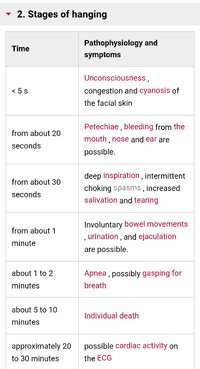
There is stated: Brain death after 10 minutes, no heartbeats after 20 to 30 minutes.
I doubt that they ever measured brain and heart activities of a person who died by hanging, but there should be a lot of clinical data around cardiac arrest and brain death. So, I am sure the periods stated in the above document about hanging are taken from clinical data, which makes sense because it makes no difference for the brain whether the heart stops beating or a noose around the neck blocks the blood flow to the brain. This was the reason why I made this statement. You are right, the dying of the brain is a process and the criterions to declare someone braindead are disputed in connection with organ harvesting and they are to a certain extend arbitrary, one criterion could for example be a flatline EEG. In our context it is sufficient that the brain is damaged so severe that a recovery is impossible and I dare to say that this is given after 12 minutes of complete blocked blood flow through the brain.
Coming to poor and lucky Alireza M.: His brain couldn´t be damaged severe because he recovered completely within a rather short time. This means, you are right and the heart was beating all the time, because there must have been a volume flow rate of blood that is too low to stay conscious but high enough to prevent a severe brain damage. A minimum flow rate is required for sufficient diffusion between cells and blood vessels. This reduction of volume flow rate must be caused by a noose which was probably positioned with the knot in front of the neck. It is very unlikely that the knot was exactly under the chin it will probably be located between ear and eye. Breathing could by possible if the knot is located like this. You will find many articles about this topic, but I found nothing about these details, so it is only conclusion and to certain extend speculative.
There are suicide videos were people pass out and die quickly although the knot was positioned between ear and eye. I also know a non-lethal hanging video where the knot was in the same position and the hanged person was still conscious when she was let down after 1 minute and 24 seconds.
If the knot is positioned between eye and ear only one carotid artery and both vertebral arteries are blocked. Thus, only one brain hemisphere is supplied with blood and obviously one damaged hemisphere is sufficient to die. Unless the circle of Willis allows a sufficient volume flow rate to keep the threatened hemisphere alive, what is normally not the case. When I was hanged non-lethally, I always positioned the knot between eye and ear and I used a non-constricting loop instead of a noose. When I was younger, I stayed conscious for about 15 seconds but this time reduces to 5 seconds with increasing age, I know the exact periods from the videos. My theory: Atherosclerosis in the circle of Willis with increasing age reduced the blood flow rate between the brain hemispheres.
I am not sure whether the story of Anne Green is only fiction.
https://en.wikipedia.org/wiki/Anne_Greene
Article: Brain damage is a medical emergency. The outlook for a person with brain injury depends on the severity of the injury and the person's overall health before the injury. Both traumatic and acquired brain damage can result in physical and mental impairment. Some people may not fully return to their cognitive function before their injury.
(Note: I've only attached the type* of brain injury that interests us; full articles are in the hyperlinks)
* Anoxic or hypoxic brain injury. These injuries occur when brain cells do not get enough oxygen.
Hypoxic and anoxic brain injury is a type of acquired brain injury that occurs when cells in the brain do not receive enough oxygen.
A hypoxic injury occurs when the brain is still able to receive some amount of oxygen, but does not get enough.
An anoxic injury occurs when oxygen is cut off completely from the brain.
Article: Brain death (also known as brain stem* death) is when a person on an artificial life support machine no longer has any brain functions. This means they will not regain consciousness or be able to breathe without support.
A person who is brain dead is legally confirmed as dead. They have no chance of recovery because their body is unable to survive without artificial life support.
Brain death can happen when the blood or oxygen supply to the brain is stopped.
* The brain stem is the lower part of the brain that's connected to the spinal cord (part of the central nervous system in the spinal column).
The brain stem is responsible for regulating most of the body's automatic functions that are essential for life. These include: breathing, heartbeat, blood pressure, swallowing.
The brain stem also relays information to and from the brain to the rest of the body, so it plays an important role in the brain's core functions, such as consciousness, awareness and movement.
After brain death, it is not possible for someone to remain conscious.
Brain death is the complete and irreversible loss of all brain function.
Brain death is a legal definition of death. It is the complete stopping of all brain function and cannot be reversed.
Brain death is death. It is permanent.
Article: Hangings were more gruesome than you might think. Unlike scenes from present-day films depicting a quick death, real hangings were often considerably more drawn out. It was customary for friends and relatives of the condemned to try to hasten the death by pulling on their feet during the hanging.
In a comprehensive 1651 account of Greene's hanging, titled Newes from the Dead, clergyman and Oxford scholar Richard Watkins writes that Greene "was turned off the ladder, hanging by the neck for the space of almost half an hour; some of her friends in the meantime, thumping her on the breast; others hanging with all their weight upon her legs, sometimes lifting her up and then pulling her down again with a sudden jerk." According to this account, their actions were so disruptive that they were reprimanded and ordered to stop.
When Greene was deemed dead, she was taken down from the gallows and placed in a coffin in a cold area. After about half an hour, her hypothermic body was presented to William Petty, an Oxford anatomist and surgeon, who intended to prepare Greene's body for dissection, which was, at that time, legally practiced on criminal corpses. Incredibly, however, he detected a faint breath.
Scientists theorize that frigid conditions, perhaps in combination with the blows to the chest she received, may have played an essential role in keeping her alive after her hanging. A 2009 article from the Journal of Medical Biography states, "A combination of low-body temperature and external (pedal) cardiac massage after her failed execution, it is suggested, helped to keep her alive."
In a hypothermic state she required relatively less oxygen. Consequently her respiration and heartbeat were reduced and went undetected, especially because she was already taken for dead.
Full text
"Individual death" = 5 to 10 min? I wish it were that fast and wonderful.
 flexikon.doccheck.com
Yes, thanks. I already saw and read it because Gustav posted it earlier.To put a little context to a low effort post, the full article can be found at:
Erhängen - DocCheck Flexikon
Als Erhängen bezeichnet man die tödliche Kompression des Halses durch ein teilweise oder vollständig um den Hals gelegtes Strangwerkzeug, wobei...
It is in german, so it was translated.
It is an intetesting read and goes over hanging suicide data from Germany.
I posted the chart with their findings in case nobody wanted to dig it out themselved.
As mentioned above, these date cannot be collected from hangings. They must be clinical date, collected in context with cardiac arrest, brain damage and organ harvest. They were extrapolated/transferred on hanging. And of course there cannot be hard figures but statistical data which should be presented as mean value and standard deviation. Of course you will almost never find pure science, scentific results are alway soaked with politics, moral and education. In this document, time until unconsciousness respectively brain death are obviously minimum values, stated to be on a save side. But their save side is not our save side, which are the maximum values.To put a little context to a low effort post, the full article can be found at:
Erhängen - DocCheck Flexikon
Als Erhängen bezeichnet man die tödliche Kompression des Halses durch ein teilweise oder vollständig um den Hals gelegtes Strangwerkzeug, wobei...
It is in german, so it was translated.
It is an intetesting read and goes over hanging suicide data from Germany.
I posted the chart with their findings in case nobody wanted to dig it out themselved.