


LastAcrobat
So Long and Thanks for all the Fish
- Nov 7, 2025
- 65
Hello people of Sasu, today we will be learning! Wow! Well, not too much, I'll keep this brief for everyone's short attention span. However, this will first start with a lesson in material science (sounds fun right?) Below is what is known as a "Stress-Stain Diagram", which describes how a materials works under various forces (aka "loads"). The diagram here is for a ductile material. Stress is a measurement of how much, well, stress, the material is under; how much force is is currently loading. Strain is the measure of deformation, how much the materials has "changed shape" with time. On the chart below, there are a lot of labels. Ignore the numbers for now, they are a surprise took that will help us later. For this interpretation there are 4 things that must be known, each of the red marks, and the gray line. The first red X, labeled with "Y", is the "yield point." Prior to the yield point, all strains and stressed the material has sustained can be reversed, and the material can easily return to normal with little to no adverse effects. This is known as elastic deformation. Beyond this point, the material will never be the same. Parallel to line prior to the yield point is the rebound line, marked in gray. This is the path that the material will follow past the yield point if the stress is removed. The material will recover significantly, but it will never fully be the same. The material will be permanently deformed. This gray line can be anywhere past the yield point, in the plastic deformation region, and will always be parallel to the line in the elastic region. Now, onto the second red X, the Ultimate Stress or Ultimate Point. Here is where the material is under the maximum load it can hold before it breaks. Beyond this, the material will often cascade rapidly out of control and fracture, denoted by the final red X, the fracture point (aka failure point, breaking point, etc.) After the ultimate point, the amount of stress the material can handle drops as its deformation rapidly increases. While recovery is still possible significant permanent damage often remains.
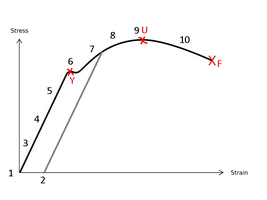
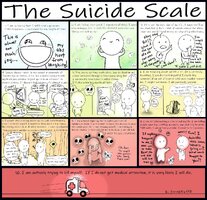
Now, you may be wondering, Acro, why did you just yap on about fucking material science for a paragraph? Do you have an exam tomorrow and you have been studying for hours and this is all you can think about? And first, damn, no need to call me out, but second, I do have a point to make. Below is an image I am pretty sure that most of you have seen. It depicts, to varying accuracy, the "suicidal level" suicidalness? not sure... of a person. To help with this analogy, I have plotted, vaguely, where I associate each point being on the stress-strain curve, assuming the brain is a... well... read the title... a ductile material. Interpreting stress as mental stress, and strain as, a vague "mental strain (mental deformation?)" (patent pending). Firstly with 1, 3, 4, and 5. This shows the brain going under more and more stress, and straining accordingly, but not too far as to cause permanent damage to the psyche. This trend continues onto point 6, but afterwards, the trend changes. Now hey, what about 2? Point 2 I interpreted as being "post recovery," being the brain having returned to a sense of normalcy and calmness, but still not the same as it was before. Things have changed, but they are better. Put, as point 2 can "move" as the "rebound line" moves, where this is may vary. Now for points 7 and 8, I see it as the brain starting to give in to the stress. The rate of strain increases, even if stress itself doesn't. It begins to bend and get damaged. Recovery is still very much possible, but not always, and it may not be the same afterwards. And this is true up to point 9, the point of ultimate stress. Beyond which, while recovery is possible, it may not be easy in the slightest, and there will be significant psychological changes when compared to prior. With 9 being the ultimate stress, 10 leads the spiral down to the breaking point, and I'm assuming you, as a very smart and bright reader, can interpret what this point represents here.
Now there are some pretty clear flaws in this interpretation. Recovery is often a lot more effective than this chart would show, being able to bring the strain much closer to the starting point than just "parallel to the start" would show. Then again this varies for everyone. And where you may place the 10 points would also be different based on your interpretation, and your own experiences. I am curious where others would place them. Also there are holes in my explanation of the diagram and how the brain works, but the analogy can vaguely hold to some extent. Is it fully accurate, no, but it can help get a point across.
Now, do not take this as a sign to not try recovery. Please, if you do see it as an option try it.
But in the end, any choice you make is up to you.
If there are any glaring errors, I will try to either fix it here, or in a reply below. Please point out anything you think I should change <3.
- LastAcrobat :3
Now, you may be wondering, Acro, why did you just yap on about fucking material science for a paragraph? Do you have an exam tomorrow and you have been studying for hours and this is all you can think about? And first, damn, no need to call me out, but second, I do have a point to make. Below is an image I am pretty sure that most of you have seen. It depicts, to varying accuracy, the "suicidal level" suicidalness? not sure... of a person. To help with this analogy, I have plotted, vaguely, where I associate each point being on the stress-strain curve, assuming the brain is a... well... read the title... a ductile material. Interpreting stress as mental stress, and strain as, a vague "mental strain (mental deformation?)" (patent pending). Firstly with 1, 3, 4, and 5. This shows the brain going under more and more stress, and straining accordingly, but not too far as to cause permanent damage to the psyche. This trend continues onto point 6, but afterwards, the trend changes. Now hey, what about 2? Point 2 I interpreted as being "post recovery," being the brain having returned to a sense of normalcy and calmness, but still not the same as it was before. Things have changed, but they are better. Put, as point 2 can "move" as the "rebound line" moves, where this is may vary. Now for points 7 and 8, I see it as the brain starting to give in to the stress. The rate of strain increases, even if stress itself doesn't. It begins to bend and get damaged. Recovery is still very much possible, but not always, and it may not be the same afterwards. And this is true up to point 9, the point of ultimate stress. Beyond which, while recovery is possible, it may not be easy in the slightest, and there will be significant psychological changes when compared to prior. With 9 being the ultimate stress, 10 leads the spiral down to the breaking point, and I'm assuming you, as a very smart and bright reader, can interpret what this point represents here.
Now there are some pretty clear flaws in this interpretation. Recovery is often a lot more effective than this chart would show, being able to bring the strain much closer to the starting point than just "parallel to the start" would show. Then again this varies for everyone. And where you may place the 10 points would also be different based on your interpretation, and your own experiences. I am curious where others would place them. Also there are holes in my explanation of the diagram and how the brain works, but the analogy can vaguely hold to some extent. Is it fully accurate, no, but it can help get a point across.
Now, do not take this as a sign to not try recovery. Please, if you do see it as an option try it.
But in the end, any choice you make is up to you.
If there are any glaring errors, I will try to either fix it here, or in a reply below. Please point out anything you think I should change <3.
- LastAcrobat :3
Last edited:


