


DarkRange55
Let them eat cake! 🍰
- Oct 15, 2023
- 2,314
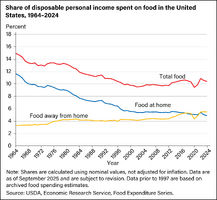
Share of disposable personal income spent on food continues to decline in 2024 | Economic Research Service
In 2024, U.S. consumers spent an average of 10.4 percent of their disposable personal incomes on food, a decrease from 10.6 percent in 2023. This decline shows a small shift in consumer spending habits. Specifically, the budget share allocated to food-at-home spending decreased from 5.0 percent...
I felt like another inflammatory post to mix up the echo chamber…


This chart is from the USDA, and as you can see there are three lines here. The vertical axis is percentage of disposable personal income, and the horizontal axis is time from 1960 to the present. Food consumed at home has fallen by a tremendous amount, from about 14% of disposable personal income to roughly 5%. There is a very small uptick here, but that uptick is from the all-time low back up to about where it was in 2013.
What is interesting here is how the portion of all food consumed is now comprised of food away from home to a much greater extent, meaning eating in restaurants. Eating in restaurants was a luxury good, and in 1960 it was only about one-fifth of all dollars spent. This light blue line plus the dark blue line combined equals the orange line of total food. So not only has total food spending been going down as a share of income, but this masks how much of a luxury choice people are making in eating away from home. Eating at restaurants is always going to be more expensive than cooking at home because you are supporting the salaries of all the staff there.
On top of that, food at home also masks a lot of processed and junk food, which necessarily is always going to be more expensive and rise at a higher price. Why does processed food and junk food increase in price at a greater rate than whole food ingredients you would make food from scratch? Because processed food has to support the salaries of food scientists designed to make things like Doritos and Cheetos more addictive, advertising campaigns, and all the fast-food ads you see on television.
It also supports marketing directors deciding what demographic to target or how to tweak a certain burger or a certain type of Mexican food item at Taco Bell. These are highly educated people. It is unfortunate that they have chosen to devote their careers to something that is not improving the human condition, but these are well-paying jobs that are generally recession-proof.
From an employment perspective, these are desirable jobs to have. When I did my MBA and this was the best possible business school, a fair number of my classmates actually went to work in branded processed food. That was a big track of employment. These were all nice people and still are, but they chose to work in packaging non-food substances as food, full of artificial flavors and chemicals. Unfortunately, that is a machine in which they are a cog.
Food at home has fallen by such an amount that this is deflation, just like we have seen in other research and deep dives. Energy prices have also continued to shrink as a percentage of household income.
A lot of conservatives like to tout not just food as the entirety of inflation, but they always use an anecdotal example rather than a chart like this. They use extremely unhealthy fast food—carbonated beverages like Coca-Cola and Pepsi, or a Big Mac, or Doritos.
They think that saying Doritos were two dollars a bag thirty years ago and now they're six dollars a bag proves we have suffered endless hyperinflation. That is somehow supposed to be a counterpoint to the data-driven proof that inflation is not nearly as high as they claim it to be.
They shouldn't be eating Doritos at all given how unhealthy they are. And because Doritos have to support a lot of highly paid people, that is why the price of that rises at a greater rate than the price of anything that would be a component of a salad you would make at home.
What is even worse is that cooking skills are declining. Even though it has been easier than ever to learn how to cook on YouTube—any recipe from any part of the world—you will see multiple videos from different perspectives. You learn faster and better when you have multiple teachers. This is much easier than relying on cookbooks that existed in the old days.
Despite the availability of all this wonderful information, people feel that they cannot cook at home and therefore eat out more often. Cooking skills went away even as access to knowledge became more commoditized. That is like saying literacy went down because public libraries became available—but sadly, that is true.
However, for those who derive their opinions from solid data, you can see that food at home going down is in fact proof of rising standards of living.
If you were to eat what your great-grandparents would consider a pretty good meal cooked at home—because they did not eat in restaurants very often—and you go back even further than 1960, to the time of your great-grandparents, they did not have processed foods with things like maltodextrin and high-fructose corn syrup.
What they would consider a very good meal is something you can purchase the ingredients for at a very low price. In fact, the price of fruits and vegetables in general has not risen in about thirty years. The price of eggs, as I have demonstrated on this forum, has only risen less than two percent a year for the last forty years.


